Liravexol
Slate Stage
Slate Stage
Couldn't load pickup availability
-
Problem Statement
When learners reach this stage, they may understand many Python concepts but still need a stronger routine for combining them. Larger tasks can feel unclear when the learner has not planned the order of code sections before writing. Data handling can also become confusing when lists, dictionaries, files, and functions appear together in one activity. Some learners need more practice reading their own code and noticing where it can be simplified. Slate Stage was created for learners who want to study Python through deeper tasks while keeping the workflow organized. -
Solution
Slate Stage gives learners a structured course path built around applied coding practice. The materials guide learners through task planning, data preparation, function design, file handling, and review habits. Each module connects explanation with examples, guided exercises, and independent practice prompts. Learners study how to move from a task idea into a readable code structure. This tier helps learners improve practical coding skills through organized repetition and careful review. -
What’s Inside
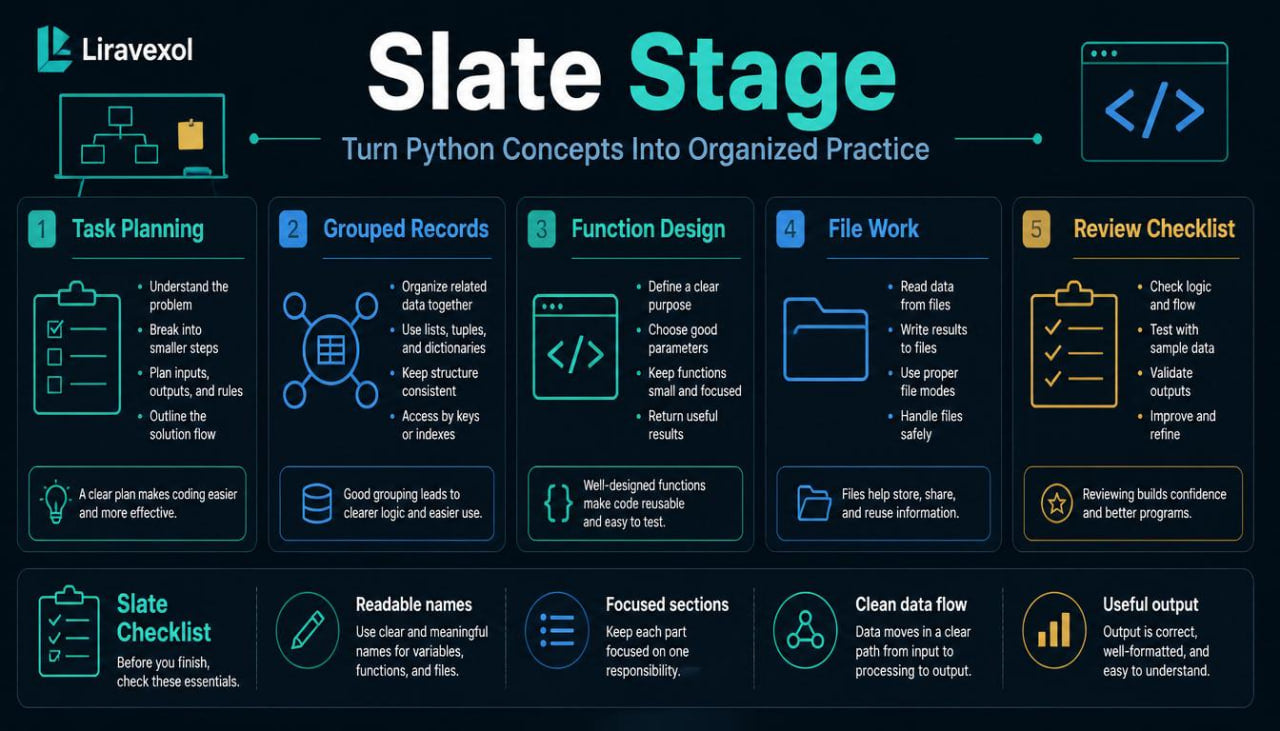
Slate Stage includes a detailed collection of Python modules focused on larger learning exercises. The course begins with a planning section that shows how to read a prompt, identify inputs and outputs, list the main steps, and choose a suitable structure before writing code. Learners study how to divide a task into preparation, logic, processing, checking, and output sections.
A major section focuses on structured data. Learners work with lists, dictionaries, nested collections, grouped records, and simple data summaries. The materials explain how to store related information, search through entries, update values, count repeated details, and organize results into readable formats. These examples help learners study how data moves through a task from the starting point to the completed output.
Another module focuses on function planning. Learners practice writing functions with focused roles, passing values between functions, returning useful results, and reducing repeated code. The course includes examples where a long code block is revised into smaller parts so learners can compare different structures and understand why organization matters.
Slate Stage also includes file-based activities. Learners practice reading text files, processing lines, cleaning values, writing output, and organizing small records. The tasks may include note sorting, record review, text cleanup, simple report-style output, and multi-step data exercises.
The course also contains review sections with questions such as: Are the names readable? Is each function focused? Are repeated parts handled neatly? Is the data structure suitable for the task? Are errors easier to locate? These review prompts help learners study coding as a process of planning, writing, checking, and improving.
Included materials may feature written lessons, coding examples, guided tasks, practice prompts, review checklists, and reference pages for functions, collections, file work, and task structure.
-
Who is this for?
Slate Stage is for learners who already understand Python fundamentals and want a broader practice course. It is suitable for people who have studied variables, conditions, loops, lists, dictionaries, functions, and file handling. This tier fits learners who want to complete longer exercises with a more organized study rhythm. It is also useful for learners who want to practice reviewing and refining their code. Slate Stage works naturally after Vertex Stage. - What You’ll Learn
- How to plan larger Python tasks before writing code
- How to divide a task into organized sections
- How to work with nested lists and dictionaries
- How to create grouped records and simple summaries
- How to design functions with focused roles
- How to pass data between different parts of a task
- How to read, process, and write simple file-based information
- How to review code for naming, structure, repeated logic, and readability
- How to complete project-style Python exercises with a steady workflow
-
30-Day Refund Note
Slate Stage may be covered by a 30-day refund window according to the store policy shown at checkout. Learners should review the refund terms before placing an order, including timing, eligibility, and how to contact the Liravexol team with order-related questions.
Self-paced learning overview
- 📁 Digital file available after purchase
- 🕒 Long-term availability
- 🔐 Secure checkout
- 🗓️ Content updated in 2026
How are Liravexol Python courses organized?
How are Liravexol Python courses organized?
Liravexol courses are arranged into clear modules with reading materials, coding tasks, and practice-focused explanations. Each course follows a structured path so learners can study one topic at a time without jumping between unrelated ideas.
Do I need prior coding knowledge?
Do I need prior coding knowledge?
Some Liravexol courses are created for new learners, while others are intended for people who already know basic coding concepts. Each tier describes its focus, learning depth, and suggested starting point so learners can choose a suitable option.
What kind of materials are included?
What kind of materials are included?
The materials may include lesson notes, coding examples, exercises, small practice tasks, concept explanations, and review sections. The goal is to help learners understand Python through steady practice and clear written guidance.
Share